The overall goal of the Machine Learning & Machine learning & image analysis core (MLIA) is to develop and provide resources for the geroscience community to aid in computer-assisted histopathological analysis and discovery of age-related histological features.
Core leader: Matt Mahoney
The MLIA has developed tools that allow for the automatic prediction of animal age from whole-slide kidney images. (Sheehan 2019, Sheehan 2024). These tools have been embedded in a user-friendly pipeline from whole-slide scanned image storage to data output. A dedicated website was created that contains the code, manuals, and instruction videos and allows interested users to set up their own image analysis pipeline and adapt the tools to analyze other tissues.
The MLIA developed a next generation void spot assay (VSA) in collaboration with Dr. Warren Ladiges to non-invasively measure bladder function (Hardy, in preparation). The VSA leverages the fact that urine flu oresces under UV light, allowing the computational characterization of voiding volumes, patterns within the cage, and voiding behavior.
We used our pipelines to assist several groups with their histological images as well as providing trainings in geropathology image analysis, including with
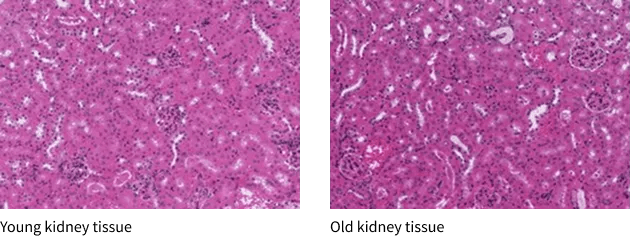
Our pipeline can easily distinguish between young kidney tissue and old kidney tissue. We can “paint” our age scores on tissues and look at where aging is happening.