
New research shows that human lung cancers use a process called alternative RNA splicing to produce different versions (isoforms) of the immune-alarm gene STAT2, shown here as ribbons. Isoforms of STAT2 are associated with how well lung cancer patients respond to immunotherapy: an isoform that retains an extra segment called an intron (top ribbon) is found in patients who respond to anti-PD-L1, while an isoform without it (bottom ribbon) is found in non-responders. These splicing signatures could one day help doctors predict, before treatment begins, which patients are most likely to benefit from immunotherapy. Credit: Jane Cha, The Jackson Laboratory.
Overlooked ‘off switch’ in lung tumors may explain why immunotherapy doesn't work for everyone
Article | October 22, 2026
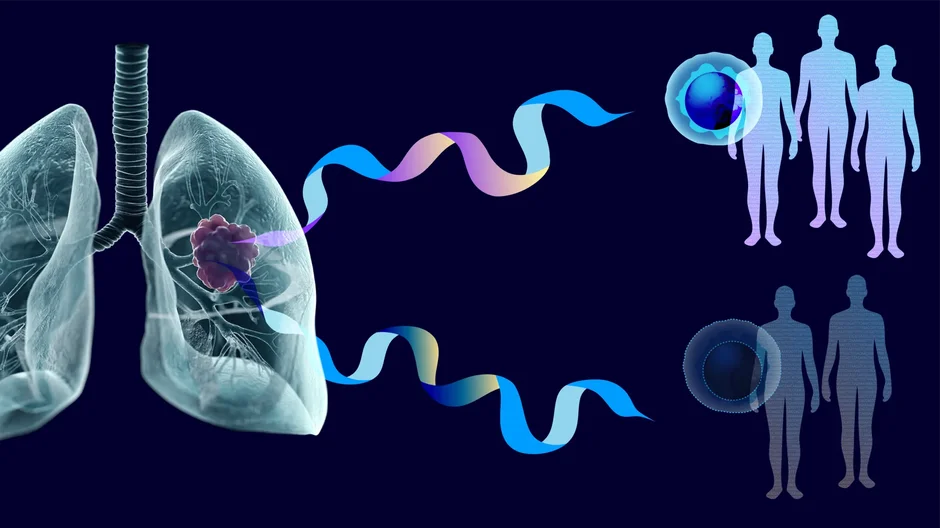
A new study shows that lung tumors can disable a key immune-alarm gene without mutating its DNA in a way doctors haven't been looking for, and that the pattern tracks with how well patients respond to treatment
Immunotherapy has transformed treatment for some people with lung cancer, helping the immune system recognize and attack tumors. But most patients still don’t respond to it, and doctors have limited tools for predicting who will benefit. Now, a team led by Olga Anczuków, professor at The Jackson Laboratory for Genomic Medicine in Farmington, Conn., and deputy director of the NCI-designated Jackson Laboratory Cancer Center, has identified a previously overlooked mechanism that may help explain why: Tumors appear to be disabling a critical immune-signaling gene without changing its DNA sequence at all.
The gene, called STAT2, acts like a relay switch that tells cells to sound the alarm when threats like viruses or tumors appear. Researchers found that some lung tumors quietly sabotage this alarm system: not by altering the STAT2 gene's DNA sequence itself, but by changing how the RNA copy made from that gene is "edited" before it is used to build a protein, a process called RNA splicing.
Published today in Science, the study was conducted at the NCI-designated Jackson Laboratory Cancer Center, in collaboration with researchers from the University of Connecticut Health Center, Hartford HealthCare Cancer Institute, Nationwide Children's Hospital, and using data generated by Genentech.
“We've had a blind spot in how we study tumors, because most of the tools scientists use can't fully see how a gene’s RNA get spliced,” Anczuków said. “Here, we found that a tumor can silence one of the immune system's key alarm genes without a single mutation just by splicing its instructions differently. That changes how we need to think about why immunotherapy fails for some patients.”

Every gene's instructions get edited before they're used
Genes are written in DNA like instructions in a manual, but cells don't use that DNA directly. First, cells make a working RNA copy of the gene. That copy is what gets edited by RNA splicing, cutting out certain sections before the final version is used to build a protein, a bit like a movie editor cutting unused footage before a film airs.
The researchers found that, in some lung tumors, the splicing of the STAT2 RNA copy goes wrong. An extra section that is usually edited out is left in by mistake, a phenomenon scientists call “intron retention.” Left uncorrected, that leftover section changes the protein the cell ends up building. The STAT2 gene itself is not mutated—the DNA is normal—it's the splicing of its RNA message that goes wrong.
The team used a newer sequencing technology called long-read RNA-sequencing, which reads a cell’s genetic messages from start to finish in one pass, like reading an entire sentence at once instead of piecing it together from scattered fragments. Applying this technology to patient lung tumors for the first time, the researchers uncovered more than 149,000 distinct versions of RNA messages. Over half of these messages had never been seen or catalogued before.
“This is exactly why we built a cancer center around genomics," said Karolina Palucka, JAX professor, director of the NCI-Designated Jackson Laboratory Cancer Center, and co-senior author of the study. "We went looking in the usual places—mutations, gene activity levels—and instead found the answer in how the genetic message itself was being assembled. It's a mechanism standard approaches would have missed, and it's now a promising lead we can pursue toward an actual test for patients.”
Not just a broken alarm—a system that actively works against you
Among the many unusual gene versions the team found, two stood out in STAT2. Both are cases of intron retention. Both reduced the amount of normal, working STAT2 protein a cell can make—like a phone with two of its wires cut, unable to fully carry an alarm call. That alone would be a problem.
But one of the two did something the researchers didn't expect: instead of just failing to work, it produced a shortened protein that actively blocked the immune alarm system from working at all. It even interfered with the normal copies of the protein still present in the cell. The researchers described the discovered mechanism as a system that actively works against the body, like a phone that isn’t just broken but it’s actively jamming every other phone's signal nearby. The researchers found that this more disruptive version accumulated when a cellular quality-control system, which normally identifies and destroys faulty RNA messages, became weakened, something that commonly occurs in cancer.
“What surprised us most is that this isn't just a broken gene sitting quietly in the background, it's actively working against the immune response,” said Ryan P. Englander, the study's first author and a graduate student at The Jackson Laboratory enrolled in the UConn Health MD-Ph.D. graduate program. “Understanding that difference matters, because it opens the door to therapies designed to correct splicing and improve the chances that a patient will respond to immunotherapy.”

A potential new way to predict who benefits from immunotherapy
To determine how findings might impact real patients, the team analyzed genetic data collected before treatment from two large clinical trials of the immunotherapy drug atezolizumab, which works by helping the immune system recognize and attack cancer cells. One trial involved lung cancer patients and the other involved bladder cancer patients.
Patients whose tumors showed more of the "actively jamming" version of the gene, relative to the milder version, tended to live longer after immunotherapy. The association remained even after accounting for other factors currently used to help predict response, including a tumor's mutation burden.
Adding the newly identified RNA pattern to mutation-count measurements roughly doubled the number of patients who could be correctly flagged as likely to benefit from immunotherapy. The effect was observed specifically in patients receiving immunotherapy, not in those receiving standard chemotherapy, suggesting that it is linked to the immune response rather than being a general marker of better health.
The researchers caution that these results were identified by analyzing data from completed clinical trials rather than prospectively testing the biomarker in new patients. Additional studies will be needed before it could be developed into a test doctors use in the clinic.
A bigger, largely unmapped world inside tumors
Beyond this one gene, the study's broader point is about scale: the vast majority of the RNA splicing patterns the team discovered in these lung tumors don't appear in the reference databases that most cancer research and testing rely on today. The authors argue that this hidden layer of tumor biology — invisible to most current sequencing approaches — likely contains other clinically important discoveries still waiting to be found.
The team has filed a provisional patent application related to correcting this splicing mistake directly, using RNA-based drugs designed to guide the cell's splicing machinery back to normal, as well as to using this splicing pattern as a way to predict immunotherapy response. Next steps include validating the biomarker in prospective clinical studies and further exploring whether RNA-targeted approaches could become therapies in their own right.
About the study
The work was led by researchers at the National Cancer Institute (NCI)-designated Cancer Center at The Jackson Laboratory for Genomic Medicine in Farmington, Conn., in collaboration with UConn Health, Hartford HealthCare Cancer Institute, Nationwide Children's Hospital, and used data generated by Genentech. It was supported by funding from the National Institutes of Health (U19AI142733, R01CA248317, R01GM138541, F30CA278494, P30CA034196) and Sanofi S.A. (SANOFI-SRA-FY19-JFB).
JAX media contact: [email protected]
Learn more about The Jackson Laboratory.
Citation: Englander RP, Brugiolo M, Devoucoux M, Wu TC, Kostich M, Leclair NK, Walawalkar I, Kang HG, Park S, Marches F, Peeples ME, Chen P, Banchereau J, Yu P, Salner A, Banchereau R, Palucka K, Anczuków O. Intron retention regulates STAT2 function and associates with immunotherapy response in lung cancer. Science. DOI: 10.1126/science.area715
Learn more

The JAX Cancer Center
The mission of the JAX Cancer Center is to discover precise genomic solutions for cancer by making basic discoveries with human impact.
View more
Cancer
By studying how cancer begins, evolves, and responds to treatment, JAX researchers are opening new paths to earlier detection, and improved patient outcomes.
View more