This AI tool helps biomedical scientists study lab mice behavior
By extracting fine‑grained movement and posture data, the tool generates behavior annotations and disease-relevant metrics that can be tied to genetics, disease models, and drug responses.
Article | July 7, 2026
(Bar Harbor, Maine – July 7, 2026) – Instead of researchers watching hundreds of hours of lab mouse videos, a new artificial intelligence system can turn footage into thousands of measurements that can then be linked to genes, disease models, or drug responses, potentially speeding the search for new treatments in humans.
Led by scientists from The Jackson Laboratory (JAX), the work has important implications for neuropsychiatric research where scientists use behavior to understand changes in genes, brain circuits, and disease, said Vivek Kumar, a JAX associate professor who led the work. Details about the technology appear on eLife.
“How do we model human traits like anxiety, depression, autism spectrum disorder, schizophrenia, and bipolar disorder in animal models? How do we know what an anxious animal looks or behaves like?” Kumar said. “We need to understand that in order to develop better therapeutics.”
Lab mice have been an integral part of biomedical research for decades, as scientists use them to investigate everything from genetic and rare diseases to chronic pain and cancer. Researchers collect data on mouse pooping and grooming habits, gait and posture patterns, or other signs of discomfort, looking for subtle changes in movement, posture, or activity that can reveal disease long before obvious symptoms appear. But one of the biggest challenges has been accurately measuring behavior, the outward signs that often reveal what is happening inside the brain and body.
Called the JAX Animal Behavior System, or JABS, the system records spontaneous behavior as animals move and interact as naturally as possible within their lab bins. The video is processed with computer vision, a form of AI that allows computers to automatically analyze patterns in images and video.
“Every time a mouse grooms, JABS annotates the frame where that grooming is happening, so we get information like whether the mouse spends 10 minutes grooming, or if it has 100 bouts of grooming,” Kumar said. “We can even detect subparts or granular features of grooming, like paw licking, where you have millisecond-long motifs.”
JABS automatically tracks body position and movement, extracting hundreds of measurements that can be used to classify behaviors. It tracks body parts such as the nose, tail, and limbs, and uses those measurements to infer behaviors and whole-body features such as grooming, posture changes, and other movement patterns. This is then turned into behavioral and disease-relevant indicators, generating hundreds of these metrics from minutes-long footage.
The team also incorporated genetics in a unique way. In addition to the software, they are releasing behavioral data from 168 mouse strains, making it possible to examine how strongly specific behaviors are influenced by genetics and to search for genes linked to particular traits.
Modernizing behavioral data
JAX scientists are already beginning to apply the approach to disease models. With JAX’s Rare Disease Translational Center (RDTC), the team is exploring whether behavioral indices can help track disease onset and response to therapy in an ultrarare neurological disorder called Rett syndrome. The hope is to uncover patterns that human observers might miss, Kumar said.
“Whereas a typical human tester may need to watch 50 mice to spot a disease-relevant feature for Rett syndrome, our system can do it with 10 or 15 mice. Human observers also need mice to be about eight weeks old to see differences, whereas [JABS] can see them at three weeks,” Kumar said. “We’re getting more sensitivity, more power, and, I would argue, more reproducibility in our experiments.”
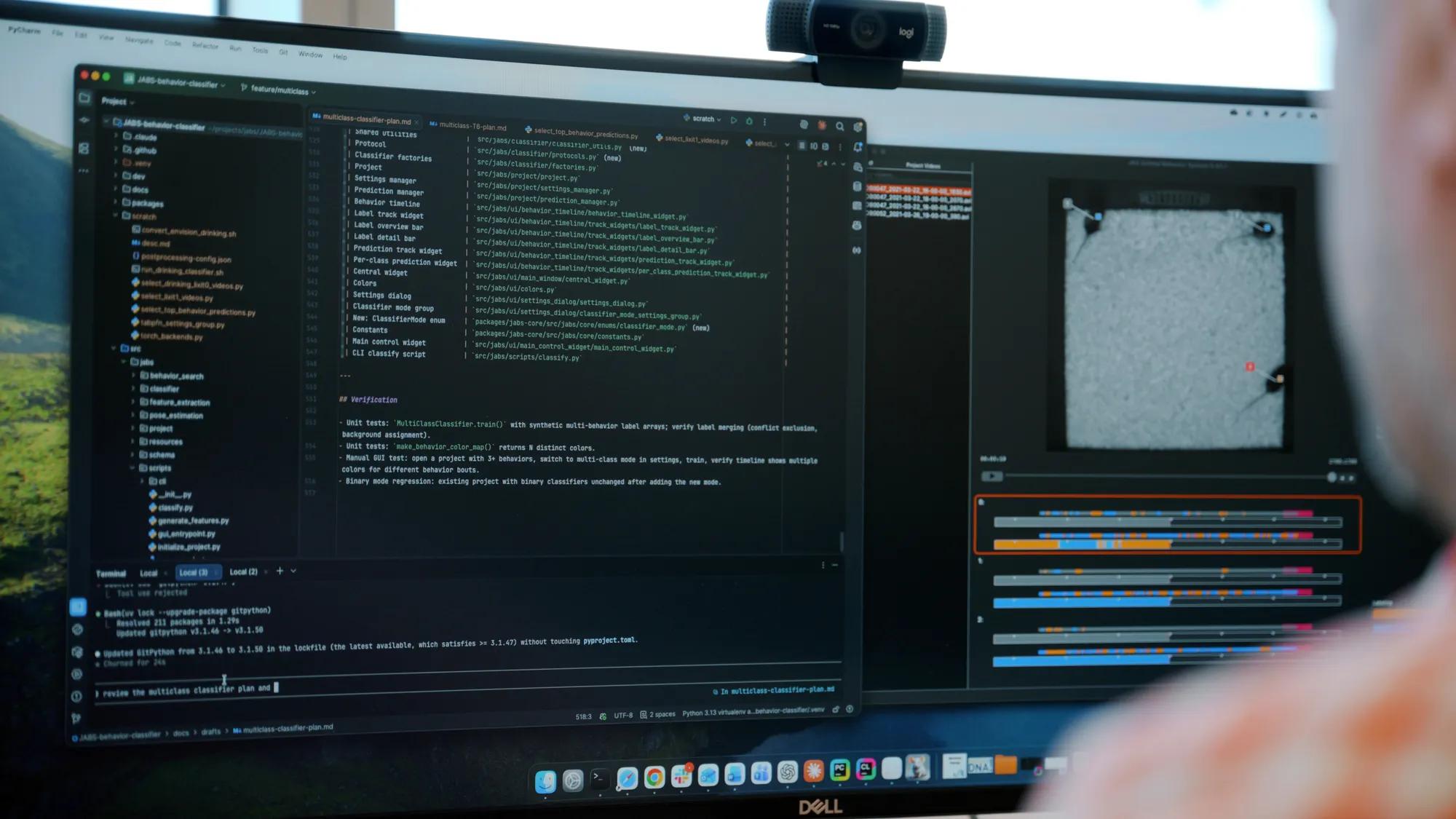
Glen Beane tracks the behaviors of mice on his computer at The Jackson Laboratory in Bar Harbor, ME.
Previous versions of the technology have already been used to study grooming behavior, posture, gait, frailty associated with aging, pain responses, seizure severity, even body mass detection. Kumar said the system can sometimes detect meaningful patterns with fewer animals than traditional observation.
“What systems like JABS give us is a much more sensitive way to capture information hidden in animal behavior and turn it into quantitative data,” said JAX’s RDTC Vice President Cathleen (Cat) Lutz. “In rare disease research, where changes can be subtle and easy to miss, that can make a transformative difference. It can help us detect meaningful effects with fewer animals, lower costs, and more confidence in the results.”
Reproducibility refers to the ability of researchers to obtain consistent results when repeating an analysis or experiment. In scoring traits like hunched backs, stiff tails, or watery eyes, the effect of the observer can sometimes be larger than the biological differences caused by experimental conditions. For example, someone with 10 years of experience could see gait deficits in a mouse that someone with less experience scores as normal.
“That subjectivity is a huge factor in preclinical research, especially in studies involving hundreds or thousands of mice,” Kumar said. “It’s especially challenging for drug development and therapeutic development, where we need reproducible and re-examinable chains of evidence.”
“Democratization” of behavioral AI was a central motivation behind the project, Kumar said. Many laboratories build their own custom systems, repeating the labor-intensive work of training models and labeling data to observe mice. JABS was designed to reduce that burden by providing objective, algorithmic measures that can be shared across labs.
As an open-source platform that is now supported by JAX Data Science, the system allows researchers to apply the same machine-learning classifiers to their own data, helping improve consistency and scalability in animal behavior research. Kumar envisions researchers using JABS to compare findings across large datasets and create a shared “map” that connects animal behavior with genetics, brain function, and disease.
We spent the last eight years building these LEGO blocks, identifying all the different behavior features, making classifiers, and validating these features,” Kumar said. “Now we can do some very serious science.
This work was supported by the National Institutes of Health (grants DA041668, DA048634, MH138309, and AG078530) and The Jackson Laboratory’s Director’s Innovation Fund.
Other authors are Anshul Choudhary, Brian Q. Geuther, Thomas J. Sproule, Glen Beane, Vivek Kohar, and Jarek Trapszo of The Jackson Laboratory.
JAX media contact: Christy Petriccione, [email protected], 203-241-9645
About The Jackson Laboratory The Jackson Laboratory (JAX) is an independent, nonprofit biomedical research institution with a National Cancer Institute-designated Cancer Center. JAX leverages a unique combination of research, education, and resources to achieve its bold mission: to discover precise genomic solutions for disease and empower the global biomedical community in the shared quest to improve human health. Established in Bar Harbor, Maine in 1929, JAX is a global organization with nearly 3,000 employees worldwide and campuses and facilities in Maine, Connecticut, California, Florida, New York, and Japan. For more information, please visit www.jax.org.
Citation: Choudhary A., Geuther B.Q., Sproule T.J., Beane G., Kohar V., Trapszo J., Kumar V. JAX Animal Behavior System (JABS), a genetics-informed, end-to-end advanced behavioral phenotyping platform for the laboratory mouse. eLife. (2026). https://doi.org/10.7554/eLife.107259.
Learn more
The Kumar Lab
We are a group of geneticists, neuroscientists, and computer scientists who are passionate about discoveries of novel targets and models for mental illness through innovation at the confluence of computational, genetic, and genomic methods.