
The Jackson Laboratory secures grant from The Michael J. Fox Foundation to advance Parkinson’s disease research through the JAX–NYSCF Collaborative
Article | June 8, 2026
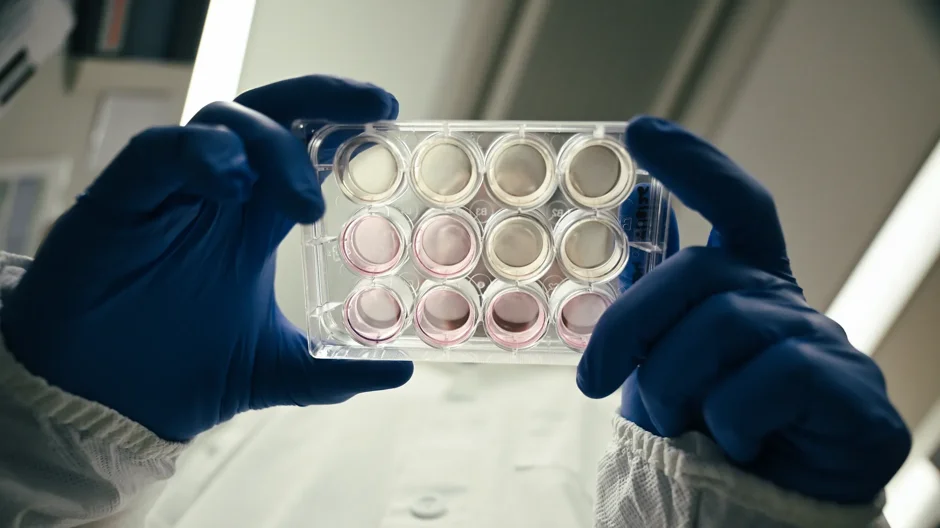
(NEW YORK – June 9, 2026) – The Jackson Laboratory (JAX) has received a $1.8 million grant from The Michael J. Fox Foundation for Parkinson’s Research (MJFF) to address a critical gap in Parkinson’s research – the limited availability of standardized, scalable human cell model systems for understanding Parkinson’s disease biology and supporting therapeutic research.
The work will be carried out through the JAX–NYSCF Collaborative, which brings together the strengths of JAX and the New York Stem Cell Foundation (NYSCF) to advance human disease modeling and accelerate biomedical discovery. GBA1 is the most commonly known genetic risk factor for Parkinson’s disease. It encodes an enzyme that breaks down specific lipids as part of the cell’s recycling system. People who carry GBA1 variants are at increased risk of developing Parkinson’s disease and often experience earlier onset and faster progression. However, researchers still do not fully understand how changes in GBA1 disrupt cell function and contribute to the disease.
“One of MJFF’s goals is to support the development of scalable and reproducible research reagents, models, and services that can help advance understanding of Parkinson’s disease biology across the field,” said Nicole Polinski, director of research resources at MJFF. “GBA1 remains one of the most important genetic risk factors linked to Parkinson’s disease, and efforts like this aim to standardize and characterize accessible human cell modeling systems that may help researchers more consistently investigate disease mechanisms and evaluate potential therapeutic approaches.”

“Many genetic variants associated with Parkinson’s disease have been identified, but for most of them we still don’t understand their functional roles or how they contribute to disease risk,” said Stefan Semrau, co-director of the JAX–NYSCF Collaborative, and principal investigator for the project. “Our goal is to standardize and characterize human cell modeling systems that directly link genetic changes to what happens in the cell, and to do so in a way that researchers and industry partners can readily use to develop new approaches for studying Parkinson’s disease and evaluating potential therapies.”
JAX-NYSCF researchers will use induced pluripotent stem cells to create standardized human brain cell models carrying GBA1 variants and to develop validated methods for studying how the GBA1 gene functions in cells. They will convert the stem cells into precisely those cell types likely relevant to Parkinson’s disease: microglia, the brain’s resident immune cells, which may play both protective and detrimental roles, and a specific population of neurons that is preferentially lost as the disease progresses. By applying advanced biochemical and microscopy assays to these models, the researchers will detect disrupted GBA1 function and its effects on the cell’s recycling system. The work will produce research methods, modeling systems, and open datasets that can also help scientists discover mechanisms underlying Parkinson’s disease and evaluate potential therapies more effectively.
The JAX–NYSCF Collaborative brings together the capabilities needed to address this challenge in a way few organizations can: an integrated platform that combines JAX’s expertise in genetics and genomics with NYSCF’s advanced stem cell and automation technologies. Together, the Collaborative can create human disease models that are not only biologically relevant, but also standardized, scalable and broadly useful to the Parkinson’s research community.
The research will be conducted in collaboration with the Early Drug Discovery Unit (EDDU) at the Montreal Neurological Institute at McGill University. The EDDU will independently validate the models and assays to ensure reproducibility across laboratories.
About The Jackson Laboratory
The Jackson Laboratory (JAX) is an independent, nonprofit biomedical research institution with a National Cancer Institute-designated Cancer Center. JAX leverages a unique combination of research, education, and resources to achieve its bold mission: to discover precise genomic solutions for disease and empower the global biomedical community in the shared quest to improve human health. Established in Bar Harbor, Maine, in 1929, JAX is a global organization with nearly 3,000 employees worldwide and campuses and facilities in Maine, Connecticut, California, Florida, New York, and Japan. For more information, please visit www.jax.org.
Media Contact: Thania Benios, [email protected], 917-930-5988
Learn more
Learn more
JAX-NYSCF Collaborative and GSK announce collaboration
Collaboration advances next-generation, human-relevant research tools to accelerate the development of treatments for Alzheimer’s disease and other neurodegenerative conditions
View more
JAX-NYSCF Collaborative
The Jackson Laboratory’s acquisition of the New York Stem Cell Foundation unites complementary strengths across mouse, cell and computational models.
View more