The Jackson Laboratory

Immunodeficient & Nude Mouse Models

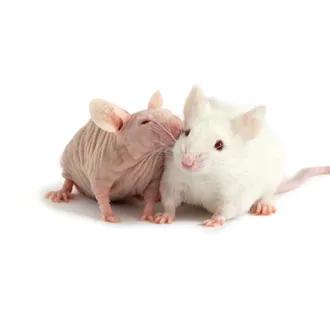
Immunodeficient animal models are characterized by a partial or complete lack of functional immune responses, resulting from genetic mutations or engineered alterations that impair components of the immune system. These models are widely used in biomedical research to study immunology, oncology, infectious diseases, and transplantation. Their reduced immune activity enables the engraftment of allogeneic or xenogeneic cells and tissues, supporting in vivo evaluation of therapeutic candidates, including drugs, biologics, and vaccines.

In addition, immunodeficient models provide a platform to investigate mechanisms of immune dysfunction and host-pathogen interactions, as well as to develop and study humanized systems for translational research. A range of models are available with varying degrees of immune impairment, from partial deficiencies to severely compromised systems, supporting diverse applications such as tumor engraftment, cell therapy evaluation, and reconstitution with human immune cells.

The Jackson Laboratory offers a variety of immunodeficient mouse models, from slightly immunocompromised (NU/J and J:NU) to extremely immunodeficient (NOD scid gamma and NOD Rag gamma), enabling a range of experimental procedures from murine cancer cell line engraftment to immune-humanization with CD34+ hematopoietic stem cells and PBMCs.

Ask an Expert about Immunodeficient Mice

The Jackson Laboratory - Immunodeficient & Nude Mouse Models

Compare Immunodeficient & Nude Research Models

Strain NamesMature B CellsMature T CellsDendritic CellsMacrophagesNatural Killer CellsComplement*Leakiness**

J:NU (007850) (outbred)

PresentAbsentPresentPresentPresentPresentN/A

NU/J (002019) (inbred)

PresentAbsentPresentPresentPresentPresentN/A

B6 Rag1 KO (002216)

AbsentAbsentPresentPresentPresentPresentAbsent

B6 Rag2 KO (008449)

AbsentAbsentPresentPresentPresentPresentAbsent

BALB/c scid (001803)

AbsentAbsentPresentPresentPresentPresentModerate

C57BL/6 scid (001913)

AbsentAbsentPresentPresentPresentPresentModerate

NOD scid (001303)

AbsentAbsentDefectiveDefectiveDefectiveAbsentVery Low

NOD scid gamma (005557)

AbsentAbsentLowLowAbsentAbsentAbsent

NOD Rag gamma (007799)

AbsentAbsentDefectiveDefectiveAbsentAbsentVery Low

*Complement - absent complement system means mice are more susceptible to pathogens and increased health barrier standards should be used for housing the mice.

**Immune leakiness - refers to the incomplete or unstable loss of immune function in an immunodeficient model, where some immune cells or immune activity persist or re-emerge despite an intended deficiency.

Immunodeficient & Nude Research Model Details

Strain NamesModel BenefitsStrain Considerations

J:NU
(007850)
Outbred Athymic Nude

NU/J
(002019)
Inbred Athymic Nude

  • Most sensitive host for cancer stem cells when compared to NOD
  • Longer lifespan than NOD scid; supports long-term engraftment studies and capabilities; >89 weeks median
  • No thymic lymphomas, can be used for long & short-term experiments
  • Sensitive to irradiation

Rag1 KO
(002216)

  • Radiation resistant, providing an alternative to scid mutants
  • Permits adoptive transfer from strains on B6 background, enabling the study of cell function and tracking of cell movement
  • Innate immunity intact
  • Poor host for primary cell transplantation

Rag2 KO
(008449)

  • Radiation resistant, providing an alternative to scid mutants
  • Permits adoptive transfer from strains on B6 background, enabling the study of cell function and tracking of cell movement
  • Innate immunity intact
  • Poor host for primary cell transplantation

Balb/c scid
(001803)

  • Engrafts the widest range of solid and hematological cancers, including ALL and AML
  • Most sensitive host for cancer stem cells when compared to NOD
  • Longer lifespan than NOD scid; supports long-term engraftment studies and capabilities; >89 weeks median
  • No thymic lymphomas, can be used for long & short-term experiments
  • Sensitive to irradiation

B6 scid
(001913)

  • Allows engraftment of allogeneic, xenogeneic, and hematopoietic cancer cell lines similarly to BALB/c scid
  • Shares C57BL/6 background with thousands of other strains allowing for crossbreeding and data comparisons
  • Improved engraftment efficiency compared to nude models for some cell lines
  • Innate immunity remains intact
  • NK cell activity limits engraftment of some primary cells and tissues

NOD scid
(001303)

  • Allows allogeneic and xenogeneic cancer cell lines & tissues
  • Engrafts hematopoietic cancer cell lines, some primary cells
  • Improvements in engraftment efficiency over nude models for some cancer cell lines
  • Innate immunity intact
  • NK cell activity limits engraftment

NSG®
(005557)

  • Higher take-rates for slow-growing cancer cell lines than BALB scid or nude xenograft models
  • Xenotransplantation of some solid human tumors
  • Develops thymic lymphomas by 8-9 months of age ~36 weeks mean survival

NRG
(007799)

  • Does not have scid-associated sensitivity to irradiation
  • Long-term multilineage hematopoietic stem cell repopulation similar to NSG® mice
  • Engrafts human PBMC without irradiation similar to NSG®
  • Engrafts a wide range of solid and hematological cancers
  • No thymic lymphomas—can be used for long-term experiments
  • Requires higher dose of irradiation to obtain human HSC engraftment

See our Complete Collection of Immunodeficient Mice on JAX Mice Search

See All JAX Immunodeficient Mice

Related Immunodeficient Model Information

Discover More

Comparing Immunodeficient Models for Cancer, Immunity, and Transplant Research

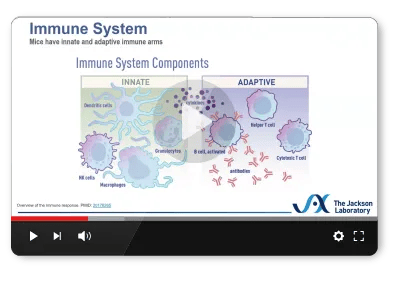
Mouse strains with varying degrees of immunodeficiency are powerful tools for modeling human disease. During this webinar, we discuss the most widely used immunodeficient mouse models and important considerations for selecting the most appropriate model.

Learn about:

  • The varying degrees of immunodeficiency in common mouse models
  • Benefits and limitations of mice with nude, scid, and Rag1-null mutations
  • Recent advancements using the versatile NOD scid gamma (NSG*) mouse strain
  • Innovations for studying human cancer made possible by the NSG mouse strain
  • Model considerations for generating “humanized” immune system mice

*NSG is a registered trademark in the USA and other countries
Watch the Video

Not what you're looking for? Find more resources

Visit our Resource Hub

JAX Webinar - Comparing Immunodeficient Models for Cancer, Immunity, and Transplant Research
Sign Up | JAX Pulse Stay informed about our events, blogs and videos, and cutting-edge research platforms.
Get Updates Right in Your Inbox

©2026 The Jackson Laboratory